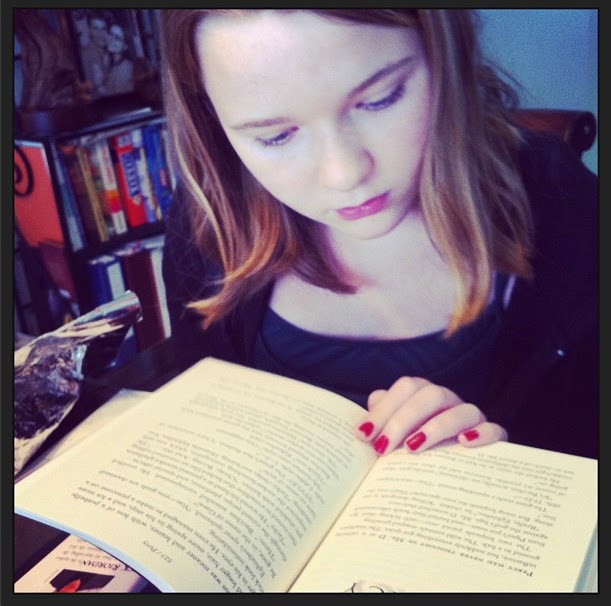
Words have always been important to me because they are how we tell our stories. It is through the telling and hearing of stories that we communicate with one another and connect in such a way that we know we are not alone.
Some of us are born with stories falling out of our mouths and dripping off of our fingers. I remember as far back as second grade, writing a story about three rebellious rabbits (Hopsy, Flopsy, and something else that rhymed) who had run away from home and taken to a life of drugs on the streets. The DARE program had clearly made a profound impact on me and driven me at the age of seven so much so that I wrote a seven-page story (front and back, no skipped lines). Side note: You have to specify "front and back" when you're seven. You have to.
Diary after diary, journal after journal, words continued to be important to me. I sloughed them off between classes in markered, bubble-lettered, origami-folded notes with arrows labelled "Pull here" and warning signs reading, "Don't open until lunch." They wore off through the day and regenerated with every conversation and observation and interaction, wending their ways into letters and poems and stories.
A multi-year spelling bee winner in elementary school and yearbook editor in middle school, I learned quickly that it was easy to impress people with your words. They would reward you for it, even label you with new words like "smart." They would put you in a category like "honors." They would keep you around but at a distance--close enough to check their homework, far enough so that some labels like "nerd" and "geek" didn't wear off you and onto them.
I'd grow, as most do, to wear those last words proudly.
By high school I had learned that words could get you into trouble. These are the stories I don't write for free.
Like words, names have power. I do not think they wield the power to determine who we become, but they certainly generate others' expectations of us. Impressions attach themselves to names so that, once we've met one by a name, we judge all others by that standard. We expect all Jennies, all Beckys, all Deborahs to be the same just like so many people have met black Deidres and then look at me, disappointed, when I walk in a room white, like I will never not do.
My name actually means "sorrowful wanderer," and I am. Some days.
I have three children, ages twelve, two years, and two months. When I named each, I named them with great hope and anticipation for the adults they would become. Each of them corresponds with a avian reference (I'm pre-Portlandia), and all of them are literary.
Daina stands for song. It is the name of traditional music or poetry from Latvia. She is my songbird. Her name's spelling has ties to dainty, and her middle name is Alivia-Lee. When I think of it all together, it occurs to me as dainty, alive, and free. It always has.

Atticus is my son, named after the noblest character in all of literature, Atticus Finch in To Kill a Mockingbird. I love how this character represents the ones who speak for those who cannot, despite the cost. Atticus is a high bar for anyone to reach, so we gave him Holden as a middle-name backup from Holden Caulfield from The Catcher in the Rye.

Evangeline Ever is our newest. Her name means "bringer of good news always." Our third bird, she's the dove and olive branch, the promise of good things to come.

When I gave my children names, I paired a word with their life and what I'd hoped it would be and who I believed they could become. I gave them names with high bars and big shoes.
These are the stories I'm telling about them before they happen, written with hope onto their birth certificates, above closet doors, in lunch boxes, and on the tags of winter coats.
I etched each letter with love, thought of every serif curve, planned how I would pen it on presents and at the bottom of Christmas cards. I played the mean girl while pregnant and imagined how it would be botched by too-tired teachers who would, after mutilating every syllable, shoo my child's corrective words away with a dismissive Frenchman's wave. I weighed the cost of the time and energy I'd spend spelling out "Daina" and explaining that it's like "Diana" but inverted. I'd forecast the pained face I'd fight each time someone cited Atticus as a character from "that really good movie," never knowing who Harper Lee was or what that book did. I knew the ways everyone would try to shorten Evangeline ("Have you thought about Angie? What about Angel? Maybe Evie?") to make it easier when I know good and well that easy is the last thing most people need.
What they need are words big enough to grow into and strong enough to pass down when they're through.